Be a Little Delusional
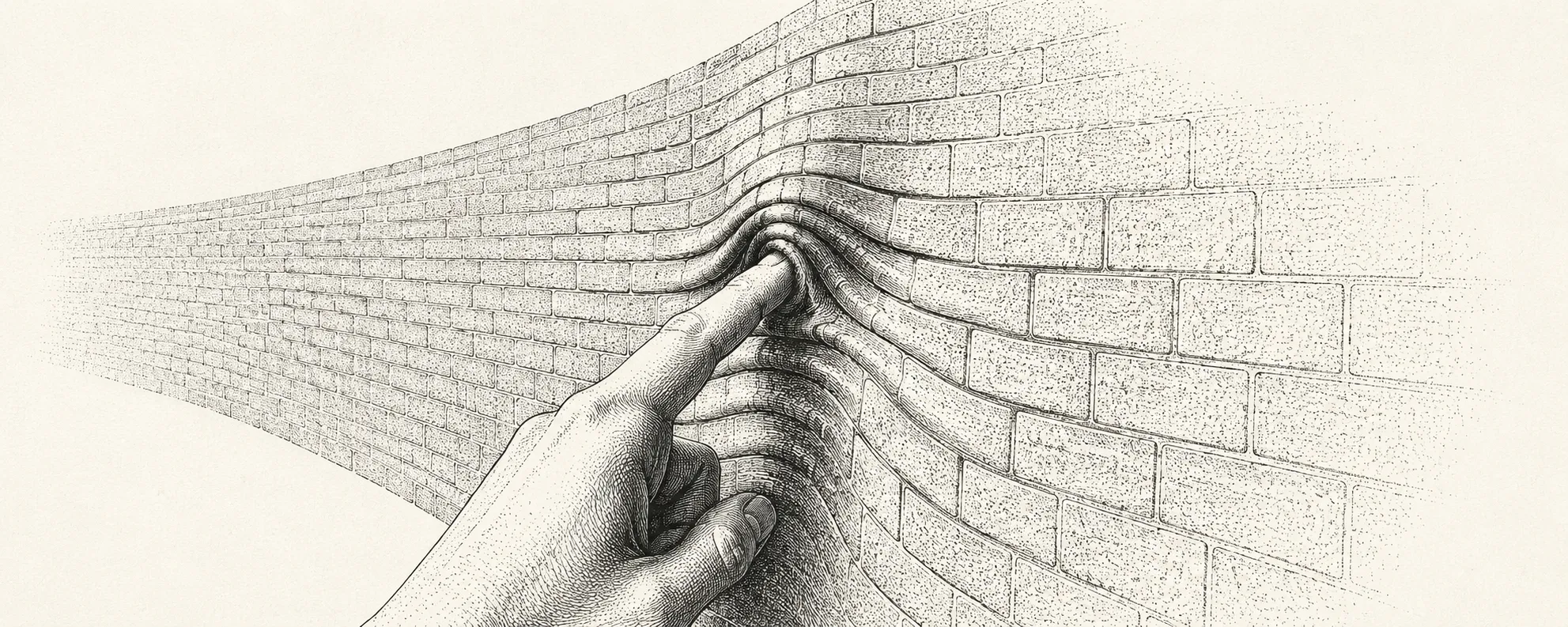
It is the most rational move you will ever make.
For anyone attempting something extraordinary, delusional self-belief is not a bug. It is the feature.
The most successful people I know share a trait nobody puts on a resume.
They are a little delusional.
Not clinically. Strategically. They believed it would work when the evidence said it would not.
And here is what most people miss. The belief was not a byproduct of their success. It was the cause.
They told you to be realistic. Keep your expectations low. Have a backup plan.
That advice protects you from disappointment.
It also guarantees it.
The Wall
Steve Jobs named the trap in a 1994 interview:
“When you grow up, you tend to get told that the world is the way it is and your life is just to live your life inside the world. Try not to bash into the walls too much. Try to have a nice family life, have fun, save a little money. But that’s a very limited life. Life can be much broader once you discover one simple fact: everything around you that you call life was made up by people that were no smarter than you. And you can change it, you can influence it, you can build your own things that other people can use. The minute you understand that you can poke life and something will pop out the other side, that you can change it, you can mold it, that’s maybe the most important thing: to shake off this erroneous notion that life is there and you’re just going to live in it, versus embrace it, change it, improve it, make your mark upon it. However you learn that, once you learn it, you’ll want to change life and make it better, because it’s kind of messed up in a lot of ways. Once you learn that, you’ll never be the same again.”
People no smarter than you built the world that you are living in it. Poke.
The Math
Start with your options. There are three.
Settle. Take the life you were handed instead of the one you wanted. Call it maturity.
Numb. Alcohol, doomscrolling, another season of a show you will not remember. Die with the song still in you.
Try. Bet on yourself. Risk looking foolish.
Now run the numbers. One more attempt costs you months. Regret costs you decades, and it compounds.
Quitting guarantees the bad outcome. Trying makes the outcome uncertain. Uncertain beats guaranteed failure. Every time.
One more variable: the size of the aim. If you have high ambitions, you achieve great things even if you fail. If you have low ambitions, you achieve very little even if you succeed.
Mark Cuban built a fortune on this math: it does not matter how many times you fail, you only have to be right once. You have forty working years. One hit pays for every miss.
This is not motivation. This is cost-benefit analysis.
The Mechanism
Belief is not woo-woo. It has a mechanism.
When you imagine a better future, your brain fires the same networks as if you were living it. Every hour of focused attention rewires you toward the person you intend to become. The delusion reshapes the hardware.
Now reframe; What if laziness is not a character flaw? What if it is a habit of staring at the cost instead of the payoff?
Shift the attention. The behavior follows.
Then there is the energy loop. You do something hard. You code it as a win.
Dopamine spikes. It cascades into adrenaline. Energy arrives. You move again.
Notice the leverage point. The coding. Two people get the same result. One codes it as progress and gets fuel. The other codes it as failure and stalls.
The coding is a choice. That choice is the whole game.
The Proof
You are thinking: what if I am just deluded?
Fair. Here is the one line killer quote:
“A lack of confidence killed more dreams than a lack of competence ever did.” Most capable people run with a speed limiter on. The capacity is there. Doubt caps it.
Here’s the hard edge: proof eats belief for breakfast. Confidence without competence is fantasy.
So you do not sit and believe. You believe and work. The reps become evidence. The evidence hardens the belief.
Delusion with a work ethic has a different name.
Conviction.
The Disclaimer
This is not a pass for entitlement.
James Clear draws the line clean. Ambition is expecting yourself to close the gap between what you have and what you want. Entitlement is expecting others to close it.
I am preaching ambition. Bet on yourself. Then work like your life depends on it.
It does.
The Quiet Period
Here is the part the highlight reels cut.
You believe. You work. Nothing happens.
For months. Sometimes years.
No applause. No traction. Just you, the work, and the silence.
Anyone can believe after the win. The test is whether you can believe before it, when the scoreboard says you are wrong.
Back yourself at the start, before you have anything to point to. Vincent van Gogh, unsold and unknown, said it from inside his quiet period: “If I’m worth anything later, I’m worth something now. For wheat is wheat, even if people think it is grass in the beginning.”
There are a million ways to win and only one way to lose: quit. When you hit a low, remind yourself this is where most people stop.
That is why most people do not win.
Most people do not fail. They quit and call it being realistic.
And if you swing at something great and miss? There is a line attributed to Nietzsche: “I know of no better life purpose than to perish in attempting the great and the impossible.”
The only true failure is shrinking from the attempt.
The Bet
A teaching from the insight meditation tradition says no one in the universe deserves your backing more than you do.
So place the bet. Alone, in the dark, before anyone shows up to agree with you.
Believe first. Work second. Let the evidence arrive third.
Call it delusion if you want. The people in the stands always do.
You get one life. What you attempt with it is the only question that matters. The only wrong answer is no answer.
Be delusional. It is the most rational move you will ever make.